
Griffin Perspectives
September 2026

By Edward Griffin, CEO of Griffin Partners
This document reflects the current views and opinions of Griffin Partners, Inc. on industry and market trends and is provided for general informational purposes only. It does not constitute an offer to sell, or a solicitation of an offer to buy, any security.
Commercial real estate has historically been a relationship-driven business, where success has been built on deep local market expertise and trusted relationships with brokers, property owners, developers, and other market participants that provide access to differentiated investment opportunities. Today, artificial intelligence is fundamentally reshaping how those competitive advantages are created, enhancing rather than replacing the value of human expertise, relationships, and investment judgment.
That advantage is being fundamentally restructured. Artificial intelligence is not replacing the judgment that drives great real estate investing; however, it is dramatically expanding the data available to inform it and the speed at which practitioners can execute. For sponsors and investors who understand this shift, the implications for site sourcing, underwriting precision, and long-term returns are significant.
Why Now Is the Right Time to Invest in Industrial Real Estate
The case for investing in industrial real estate at this juncture is compelling on multiple dimensions, and the convergence of structural demand tailwinds with constrained new supply creates a particularly favorable entry environment. Industrial has outperformed every other major commercial real estate sector on a total return basis since 2018, driven by the compounding effects of e-commerce growth, domestic manufacturing expansion through reshoring and near-shoring initiatives, and accelerating functional obsolescence of older product. These demand drivers are not cyclical; they are structural, and the forces animating them are, if anything, intensifying.
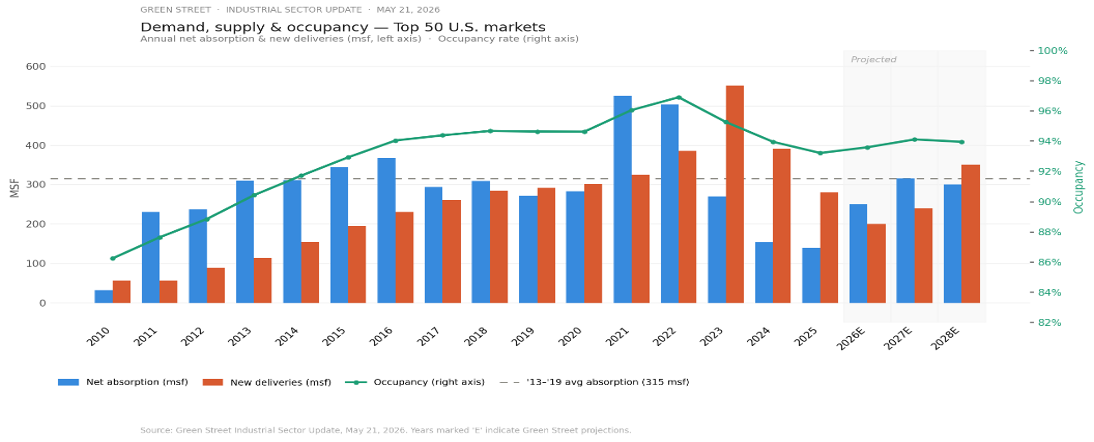
At the same time, new supply has been encountering headwinds. Municipal resistance to industrial zoning, rising construction costs, and land scarcity in high-demand infill markets have combined to constrain the development pipeline in a manner that supports sustained rent growth. According to GreenStreet, industrial space demand is projected to rebound from a cycle low of ~140 million square feet (MSF) to ~250 MSF this year before strengthening further in 2027. Over the next three years net absorption across the top 50 U.S. markets is projected to average ~290 MSF per year while new supply averages only ~260 MSF annually, meaning demand is forecast to persistently exceed deliveries in the near and intermediate term.
The shallow bay format - 20,000 to 150,000 square foot multi-tenant-asset presents an especially attractive risk-return profile within the broader industrial universe. Inventory growth in this format has been only 10.9% since 2010, compared to 41.3% for larger formats, reflecting the structural difficulty of assembling appropriately sized infill sites. JLL data shows that shallow bay’s six-year NNN rent CAGR accelerated from 4.4% (2013–2019) to 8.0% (2019–2025), and investment liquidity in the format rose 32% year-over-year in the first quarter of 2026, with shallow bay commanding a persistent asking rate premium over other industrial formats.
Taken together, these dynamics describe a market in which the fundamental drivers of rent growth and value creation are supply-constrained and durable, precisely the environment in which basis and execution matter most.
Relationships Enhanced by Data-Driven Sourcing
Traditional site sourcing in commercial real estate depended on local broker networks, years of market presence, and access to off-market or narrowly marketed deal flow. Those relationships still matter — but AI is compressing the informational advantage that relationships once provided and creating new gains for those willing to invest in better tools and the processes to use them with discipline.
AI-powered platforms now aggregate fragmented property, tenant, and market data in real time — pulling together parcel records, zoning conditions, trade flow patterns, consumer demand signals, and logistics network efficiency into a single analytical layer. New companies are offering geospatial tools that allow developers to identify high-priority sites with a speed and precision that was impossible even five years ago. Griffin Partners is at the forefront of this progress.
Reshaping What Tenants Demand
AI is also reshaping the nature of industrial tenant demand itself, and this matters for investors thinking about long-term asset quality. Warehouse automation, AI-driven logistics optimization, and robotics require facilities with different footprints, higher clear heights, greater power capacity, and more sophisticated infrastructure. Modern tenants increasingly evaluate facilities not just by square footage but by output per cubic foot and operational throughput capability; these are metrics that favor newer, institutional-quality assets and accelerate obsolescence for older stock.
Power availability has emerged as a primary constraint in this environment. Markets with reliable, scalable electrical infrastructure are capturing disproportionate demand as automated facilities require dramatically more power than conventional warehouses. This dynamic is creating durable supply barriers in select markets, exactly the type of structural advantage that supports rent growth and long-term asset value.
Griffin Partners: A Decade of Intentional Investment in Innovation
Recognizing more than a decade ago, before it became industry convention, that data and technology would fundamentally reorder the competitive landscape in commercial real estate, Griffin Partners began investing heavily in technology and analytical processes. Griffin Partners is driven by the conviction that disciplined technology adoption could provide a meaningful and enduring competitive edge over larger rivals.
These capabilities are most evident in industrial development site sourcing, where Griffin has partnered with a specialized geospatial data science firm to enhance site selection. Griffin’s proprietary AI-driven tool aggregates geospatial data for any parcel, listed or not, alongside demand drivers derived from Griffin’s historical investment data, enabling rapid identification of land parcels situated in emerging growth corridors. Opportunities are ranked according to proprietary acquisition and development criteria, incorporating zoning designation, probabilities for permitting friction, proximity to major highway infrastructure, site plan viability, and truck traffic data, among dozens of other critical metrics—allowing Griffin’s investment team to prioritize pursuit efforts with a speed and precision that was simply unavailable to the market a decade ago.
The competitive implications are significant. By identifying and securing high-quality development sites before they surface on the open market, Griffin is often able to acquire land at prices that reflect pre-discovery value rather than bid-up institutional pricing. In this asset class, disciplined entry pricing is often cited as one of the more consequential drivers of long-term performance. It is the kind of durable, technology-enabled advantage that a smaller, focused firm can leverage as part of its broader investment approach.
The Balance That Matters: Data and Judgment
We want to be direct about something: AI tools enhance investment decision-making, but they do not replace it. The best outcomes will come from firms that combine strong data infrastructure with experienced, market-grounded judgment. Data without context can produce flawed conclusions; relationships without data leave opportunity on the table.
As these tools become more widely adopted across the industry, the edge will shift from simply having access to AI-powered analytics toward the ability to interpret and act on those insights with precision and speed. Competitive advantage will accrue to platforms with proprietary data, disciplined underwriting processes, and the operational capability to execute, rather than simply licensing the same software.
Griffin Partners: Our Approach
At Griffin Partners, technology-enabled investment selection is a core part how we approach the market, and we look to integrate AI-driven analytics across stages of the investment lifecycle, from parcel identification and market selection through underwriting, asset management, and portfolio construction, while preserving the local relationships and execution capability we have built over time.
The firms that generate the strongest returns in industrial real estate over the next decade are likely to be those that combine modern product, data-driven execution, and exposure to the structural demand driven by automation and onshoring.
Important Disclosures
- This document has been prepared by Griffin Partners, Inc. for general informational purposes only and reflects the current views and opinions of Griffin Partners as of the date hereof, which are subject to change without notice. Unless otherwise noted, all statements and information contained herein are made as of September 9, 2026, and nothing herein should be construed to imply that the information contained herein is accurate as of any other date.
- Nothing in this document constitutes an offer to sell, or a solicitation of an offer to buy, any security, nor should anything herein be construed as investment, legal, tax, or other advice. Any offering of interests in any investment vehicle sponsored by Griffin Partners will be made only by means of definitive offering documents, which contain a more complete description of the applicable risks, fees, and terms and which alone should be relied upon in connection with any investment decision. Prospective investors should consult their own legal, business, and tax advisors regarding any investment decision.
- This document contains forward-looking statements and opinions regarding market conditions, industry trends, and business strategy. These statements reflect Griffin Partners’ current expectations and assumptions, which are subject to significant uncertainties and may prove incorrect. Undue reliance should not be placed on any forward-looking statements contained herein. Actual outcomes may differ materially from those expressed or implied, there is no assurance that any such statements will prove to be accurate, and Griffin Partners undertakes no obligation to update these statements.
- References to Griffin Partners’ investment approach, sourcing capabilities, or track record are provided for illustrative purposes only. Undue reliance should not be placed on any historical performance information included in this document given differences in market conditions, timing, costs, leverage, and other factors. There is no assurance that any strategy, trend, or advantage described herein will continue or will result in favorable outcomes for any current or future Griffin Partners investment vehicle.
- An investment in any investment vehicle sponsored by Griffin Partners is speculative and involves a high degree of risk, including the potential loss of principal and the risk that an investor could lose all or a significant amount of its investment. Such investments are generally illiquid, and investors should be prepared to bear the financial risks of an investment for an indefinite period of time.
- Certain information contained herein has been obtained from third-party sources, including GreenStreet and JLL, believed to be reliable. Griffin Partners has not independently verified this information and makes no representation as to its accuracy or completeness. Market data is subject to change and may become outdated.
- Past performance is not indicative of, and is not a guarantee of, future results, and a risk of loss exists.
- Griffin Partners has not authorized any person to provide information or make any representation with respect to the matters described herein other than as set forth in this document, and any such information or representation, if given or made, should not be relied upon.